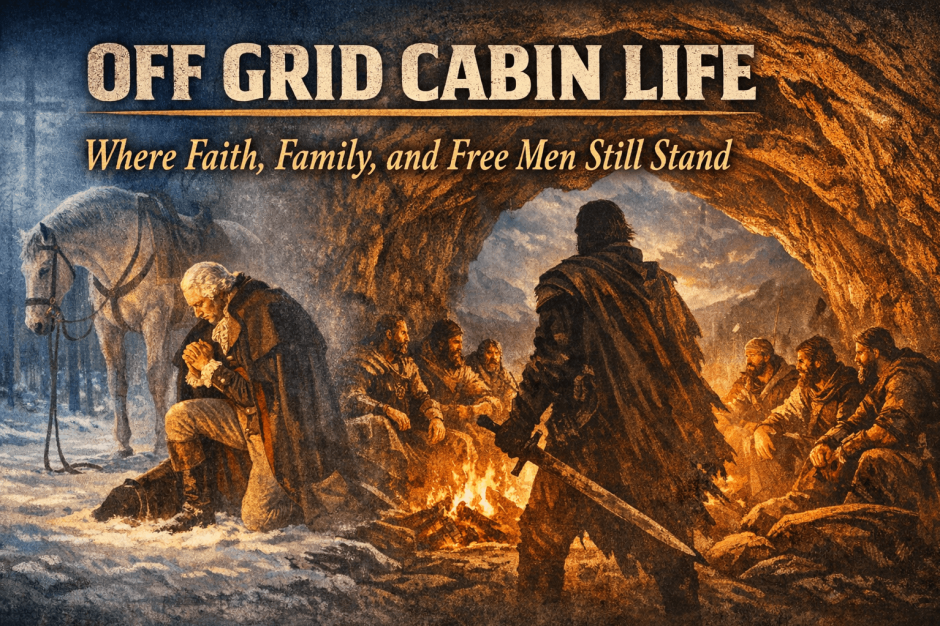
A blended family dad at the fork in the road — and what each path actually looks like six months from now.
“Behold, how good and pleasant it is when brothers dwell in unity!” — Psalm 133:1
Consider two men. Same homestead. Same blended family. Same difficult winter stretching out ahead of them. Same kids who didn’t choose each other, same fragile stepfamily dynamic, same quiet fear that if something doesn’t shift soon, the distance between these kids will harden into something permanent. Everything is identical — except one decision each man makes at the start of the season.
Path A — Nothing Changes
Six months from now, spring arrives on the homestead. The firewood got split. The pantry got stocked. Winter prep happened — but it happened in parallel, not together. Dad handled most of it. The older kids did their assigned chores and retreated to their rooms. The younger ones drifted toward screens when no one was looking.
There were no fights. But there was no bonfire story either. No moment where one kid helped another through something hard and they both felt it. The season passed like a transaction — tasks completed, boxes checked, family still strangers wearing the same last name.
By spring, the teenagers have quietly finished their calculation. They’ve decided this is a house, not a home. They’re counting months, not making memories. Dad can feel it — that low-grade grief of watching a window close. He did everything right on the homestead. The barn is tight. The roots are stored. But the thing he was really trying to build didn’t get built.
Nothing dramatic happened. That’s the honest truth about Path A. It isn’t a disaster. It’s a slow drift — and that’s exactly what makes it so dangerous.
Path B — Something Shifts
Same man. Same starting point. But this version of him approached the season differently. He didn’t just assign tasks — he designed experiences. He gave the kids a problem to solve together: How do we feed this family through February if a storm knocks out access for two weeks? He made them the answer, not himself.
There were still hard days. One kid resented another’s suggestion. Someone quit on a cold afternoon. But Dad absorbed it — didn’t collapse, didn’t escalate — and kept the mission moving forward. Nehemiah didn’t stop building when the walls got hard. Neither did this father.
By midwinter, something small but real happened around the fire. A stepbrother showed a stepsister how to split kindling without losing fingers. She laughed. He felt proud. Nobody announced it as a breakthrough, but it was. Those moments compounded quietly, the way manure spread across soil grows things that a hoarded pile never could.
By spring, they don’t have a perfect family. They have a real one — with shared language, shared labor, and one winter they all remember together. That is the beginning of something that doesn’t break apart when the kids leave for college. That is the root system of an actual family.
The Difference
The gap between Path A and Path B is not talent. It is not a perfect family situation or an easier set of kids. It is one thing: a structured framework that turns shared tasks into shared identity.
When the incentive structure is right — when kids are rewarded for genuine contribution rather than just compliance — behavior changes. The whole ecosystem shifts. This is not a parenting theory. It is the same principle that transforms any group of individuals into a team with a mission.
The dad in Path B did not have more hours in his day.